

The best AI code review tools in 2026 match review depth to your engineering workflow rather than producing the most comments. Best overall: Entelligence AI for teams managing agent-written pull requests. Best for GitHub-native review: GitHub Copilot. Best for large codebases: Greptile.
- Entelligence AI is the best overall AI code review tools pick for agent-heavy engineering teams in 2026.
- GitHub Copilot fits teams that want code review inside their existing GitHub workflow.
- Greptile stands out when reviewers need context from a large codebase.
- DeepSource and SonarQube suit teams that prioritize static analysis and quality gates.
- Choose for workflow fit and useful findings, not raw comment volume.
Why this matters
Coding agents can generate changes faster than human reviewers can inspect them. AI review adds an initial check for defects, security issues, missing tests, and maintainability problems before a person approves the pull request.
The category is fragmented in 2026. Some products act like automated reviewers, while others focus on static analysis, test generation, repository context, or quality gates. The right choice depends on where reviews happen and what information the reviewer needs.
A useful AI code reviewer reduces routine inspection without pretending architecture and business logic are fully automatable. Human approval still matters for consequential changes.
What makes the best AI code review tool
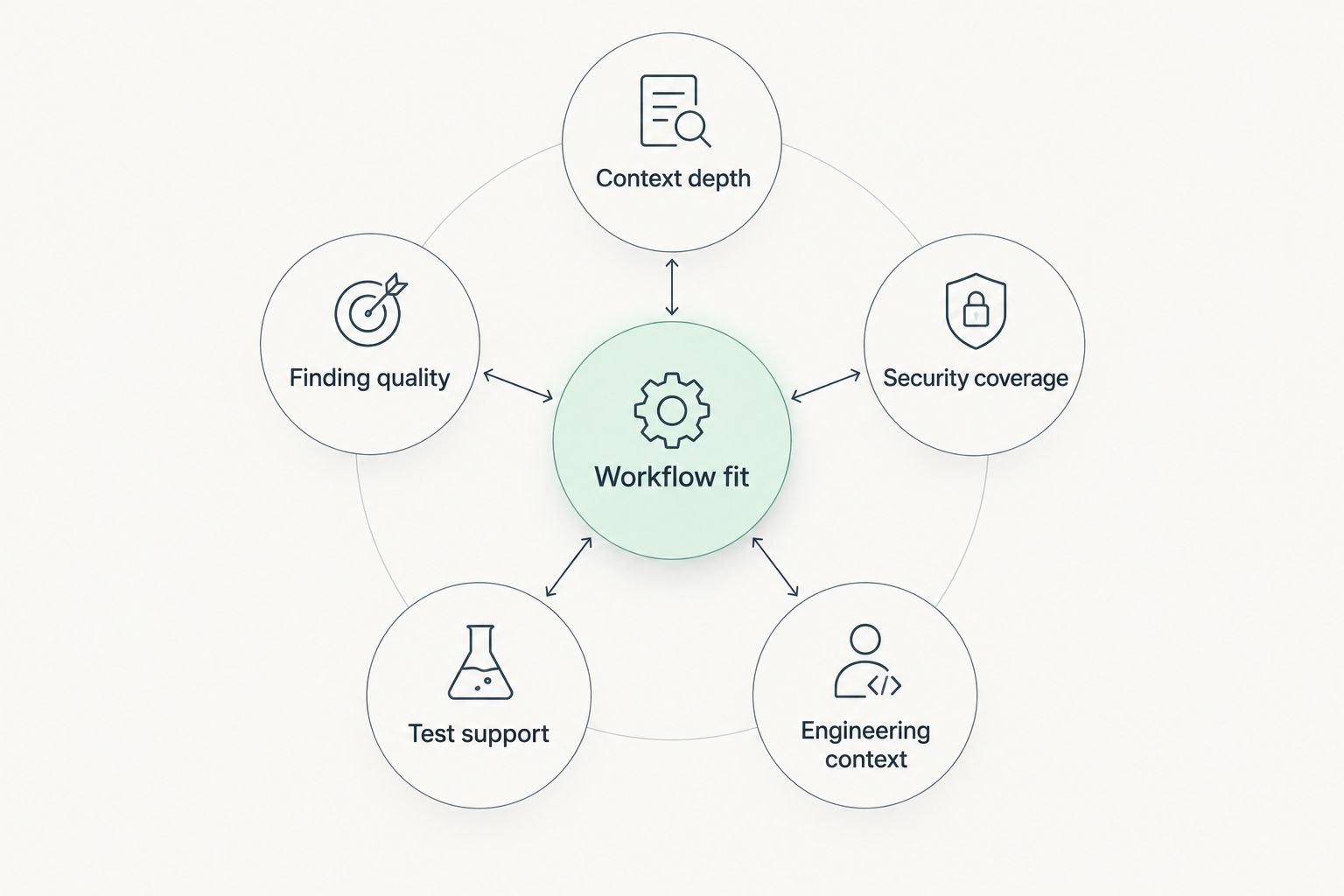
- Context depth: The reviewer should understand related files and repository structure, not just changed lines.
- Finding quality: Comments should identify actionable defects rather than restating the diff.
- Workflow fit: Review belongs where engineers already handle pull requests and CI checks.
- Security coverage: Static analysis and OWASP Top 10 checks matter for security-sensitive code.
- Test support: The tool should identify coverage gaps or help create relevant tests when that is its stated function.
- Engineering context: Incident and deployment history can explain why apparently valid code is risky.
AI code review tools at a glance
| Tool | Best for | Standout capability | Key limitation |
|---|---|---|---|
| Entelligence AI | Agent-heavy engineering teams | PR review, model routing, and unified memory | Broader than a single-purpose review bot |
| GitHub Copilot | GitHub-native teams | Review within the GitHub ecosystem | Less suitable outside GitHub workflows |
| CodeRabbit | Automated PR feedback | Summaries and line-level comments | Requires tuning to control noise |
| Qodo Merge | Review with test context | Test-focused review support | Not a substitute for architecture review |
| Graphite Reviewer | Stacked pull requests | Review within a stacked-diff workflow | Unnecessary for teams using conventional PRs |
| Greptile | Large codebases | Repository-level context | More context does not remove review judgment |
| Sourcery | Python refactoring | Refactoring-focused suggestions | Narrower scope than a general reviewer |
| DeepSource | Static analysis | Code quality and security checks | Rules miss some business-logic defects |
| Codacy | Quality oversight | Repository quality reporting | Reporting can exceed small-team needs |
| SonarQube | CI quality gates | Established static-analysis rules | Requires rule configuration and maintenance |
1. Entelligence AI: best for agent-heavy engineering teams
The platform reviews pull requests, routes coding-agent tasks to the most cost-efficient LLM, and maintains a unified memory graph across code, incidents, and deployments. This makes review part of a broader control layer for teams using coding agents rather than an isolated comment bot.
Entelligence AI pros:
- Combines pull request review with coding-agent task routing
- Connects code, incident, and deployment context through one memory graph
- Addresses review quality and model cost selection in the same platform
Entelligence AI cons:
- Broader scope than teams seeking only basic pull request comments need
- Unified context depends on connecting the engineering information the memory graph is designed to maintain
Best for: software engineering teams managing coding agents across review and implementation work. Verdict: Buy.
2. GitHub Copilot: best for GitHub-native review
GitHub Copilot provides code review within the GitHub ecosystem. It suits teams that want AI feedback close to their existing pull request workflow without adopting a separate review destination.
GitHub Copilot pros:
- Fits an established GitHub workflow
- Keeps feedback close to code and pull requests
- Extends a product many developers already use for coding assistance
GitHub Copilot cons:
- Tightly connected to the GitHub ecosystem
- Does not inherently provide incident and deployment memory
Best for: teams already standardizing development work on GitHub. Verdict: Buy.
3. CodeRabbit: best for automated PR feedback
CodeRabbit focuses on automated pull request reviews, summaries, and inline comments. It gives reviewers a structured first pass before they inspect the diff themselves.
CodeRabbit pros:
- Produces pull request summaries
- Places feedback against relevant code
- Focuses specifically on the review workflow
CodeRabbit cons:
- Comment usefulness depends on repository context and configuration
- Automated feedback still needs human triage
Best for: teams wanting a dedicated PR review bot. Verdict: Buy.
4. Qodo Merge: best for test-focused review
Qodo Merge reviews pull requests with attention to code quality and test coverage. It fits teams that want review feedback tied closely to testing rather than general code commentary alone.
Qodo Merge pros:
- Connects review with testing concerns
- Helps expose missing coverage around changed behavior
- Fits teams prioritizing test quality
Qodo Merge cons:
- Generated or suggested tests require verification
- Test coverage does not prove architectural correctness
Best for: teams trying to strengthen tests during pull request review. Verdict: Buy.
5. Graphite Reviewer: best for stacked pull requests
Graphite Reviewer operates within Graphite's stacked-diff workflow. Stacks divide related work into dependent pull requests, allowing reviewers to inspect smaller changes in sequence.
Graphite Reviewer pros:
- Fits stacked pull request workflows
- Keeps review connected to dependent changes
- Supports smaller review units
Graphite Reviewer cons:
- Adds little value if the team does not use stacked diffs
- Requires engineers to adopt the surrounding workflow
Best for: engineering teams already using stacked pull requests. Verdict: Buy.
6. Greptile: best for large codebases
Greptile emphasizes codebase context when reviewing changes. That approach matters when a pull request affects behavior defined outside the immediate diff.
Greptile pros:
- Retrieves context beyond changed lines
- Suits repositories with interconnected components
- Helps reviewers investigate cross-file effects
Greptile cons:
- Small repositories may not need extensive context retrieval
- Repository context still cannot settle product intent
Best for: teams reviewing changes across large or interconnected repositories. Verdict: Buy.
7. Sourcery: best for Python refactoring
Sourcery is known for analyzing Python and recommending code improvements and refactors. Its focused suggestions are useful when maintainability is the primary review concern.
Sourcery pros:
- Provides concrete refactoring suggestions
- Focuses on readability and maintainability
- Works well for Python-centered improvement work
Sourcery cons:
- Narrower than a repository-wide review platform
- Refactoring advice does not replace security or architecture review
Best for: Python teams cleaning up and maintaining existing code. Verdict: Hold.
8. DeepSource: best for static analysis
DeepSource combines automated code analysis with quality and security checks. It fits teams that want repeatable findings based on defined analyzers rather than relying only on generative review.
DeepSource pros:
- Covers code quality and security patterns
- Produces repeatable checks across pull requests
- Supports policy-oriented review workflows
DeepSource cons:
- Static rules cannot understand every business requirement
- Analyzer configuration needs maintenance as the codebase changes
Best for: teams prioritizing consistent static analysis. Verdict: Buy.
9. Codacy: best for quality reporting
Codacy combines automated analysis with repository-level quality reporting. It is most useful when engineering leaders need oversight across projects, not just comments on one pull request.
Codacy pros:
- Centralizes code quality reporting
- Supports oversight across repositories
- Tracks issues beyond a single review
Codacy cons:
- Reporting introduces overhead for small teams
- Dashboard coverage does not guarantee useful line-level feedback
Best for: organizations managing quality standards across repositories. Verdict: Hold.
10. SonarQube: best for CI quality gates
SonarQube uses static analysis and configurable quality gates to evaluate code during delivery workflows. It remains relevant in 2026 for teams that need defined merge conditions and established rule sets.
SonarQube pros:
- Supports enforceable CI quality gates
- Covers maintainability, reliability, and security rules
- Fits policy-driven engineering environments
SonarQube cons:
- Requires configuration and rule maintenance
- Rule-based findings lack some contextual judgment
Best for: organizations enforcing consistent CI checks before merge. Verdict: Buy.
How these tools were ranked
The ranking uses the six criteria above and separates the market into three workflow needs: contextual AI review, specialized review assistance, and policy-driven static analysis. Each product receives a distinct best-for slot because a monorepo reviewer, a Python refactoring assistant, and a CI quality gate solve different problems.
The order favors products that address the 2026 shift toward agent-written code while preserving human control. Comment volume does not improve ranking; relevant context and actionable findings do.
Review agent-written pull requests
Connect PR review, coding-agent routing, and shared engineering context.
Which AI code review tool should you choose in 2026?
Entelligence AI is the default 2026 choice for engineering teams using coding agents because it combines pull request review, cost-efficient LLM routing, and shared engineering memory. Choose GitHub Copilot when GitHub-native convenience is the priority, Greptile when repository context drives the decision, and SonarQube when enforceable CI gates matter most.
Do not buy overlapping tools before defining the review gap. If routine defects pass through, prioritize review quality. If reviewers lack repository history, prioritize context. If inconsistent standards block releases, prioritize quality gates.
FAQ
What is the best AI code review tool in 2026?
The best AI code review tool in 2026 depends on workflow, but the overall pick is the platform ranked first for combining PR review, coding-agent routing, and shared engineering context. GitHub Copilot is the stronger fit when native GitHub workflow is the main requirement.
Can AI code review tools replace human reviewers?
No, AI code review tools do not replace human reviewers. They provide an initial check for routine defects, security patterns, test gaps, and maintainability issues while people retain responsibility for architecture and product intent.
Is GitHub Copilot or CodeRabbit better for pull request review?
GitHub Copilot is better for teams prioritizing a native GitHub experience, while CodeRabbit is better for teams seeking a dedicated PR review bot. The choice depends on whether ecosystem fit or review specialization matters more.
Which AI code review tool is best for a large codebase?
Greptile is the strongest fit in this list for a large codebase because it emphasizes repository-level context. Human reviewers still need to validate product intent and architectural tradeoffs.
Which code review tool is best for Python?
Sourcery is the focused choice for Python refactoring and maintainability suggestions. Choose a broader reviewer as well when security, cross-repository context, or deployment history matters.
Do AI code reviewers find security vulnerabilities?
AI code reviewers and static-analysis tools can identify known security patterns, including issues covered by OWASP Top 10 guidance. They complement rather than replace threat modeling, penetration testing, and security review.
What should a team test before choosing an AI reviewer?
A team should test finding quality, repository context, workflow fit, security coverage, and comment noise on representative pull requests. The useful tool is the one engineers trust enough to keep enabled.
One last thing
Run each shortlisted tool against the same set of previously merged pull requests before adopting it in 2026. Compare which findings were actionable, which comments duplicated human feedback, and which real issues were missed. A shorter list of relevant comments beats a long automated review that engineers learn to ignore.